
Limited-Time Summer Sale 25% Discount Offer - Apply Coupon Code: Save25
Certs Blitz
See all results for ""
Home Exams
CRISC ISACA CISSP ISC2 200-301 Cisco SY0-701 CompTIA AZ-104 Microsoft AI-900 Microsoft AIGP IAPP 1Z0-1067-26 Oracle View All Exams →
Sign in Create account
Associate-Cloud-Engineer EXAM PREPARATION

Prepare Smarter for the Associate-Cloud-Engineer Exam

Build your exam confidence with flexible preparation resources designed around the latest Associate-Cloud-Engineer exam objectives. Practice at your own pace using PDF questions, online exam simulations, or desktop practice software.

Download Exam View Entire Exam
Page: 1 / 1
Question #1 (Topic: Demo Questions)

Youare configuring Cloud DNS. You want !to create DNS records to pointhome.mydomain.com,mydomain.com. andwww.mydomain.comto the IP address of your Google Cloud load balancer. What should you do?

A.

Create one CNAME record to point mydomain.com to the load balancer, and create two A records to point WWW and HOME lo mydomain.com respectively.

B.

Create one CNAME record to point mydomain.com to the load balancer, and create two AAAA records to point WWW and HOME to mydomain.com respectively.

C.

Create one A record to point mydomain.com to the load balancer, and create two CNAME records to point WWW and HOME to mydomain.com respectively.

D.

Create one A record to point mydomain.com lo the load balancer, and create two NS records to point WWW and HOME to mydomain.com respectively.

Correct Answer: C
Question #2 (Topic: Demo Questions)

You want to deploy a new containerized application into Google Cloud by using a Kubernetes manifest. You want to have full control over the Kubernetes deployment, and at the same time, you want to minimize configuring infrastructure. What should you do?

A.

Deploy the application on GKE Autopilot.

B.

Deploy the application on GKE Standard.

C.

Deploy the application on Cloud Functions.

D.

Deploy the application on Cloud Run.

Correct Answer: B
Question #3 (Topic: Demo Questions)

You want to select and configure a cost-effective solution for relational data on Google Cloud Platform. You are working with a small set of operational data in one geographic location. You need to support point-in-time recovery. What should you do?

A.

Select Cloud SQL (MySQL). Verify that the enable binary logging option is selected.

B.

Select Cloud SQL (MySQL). Select the create failover replicas option.

C.

Select Cloud Spanner. Set up your instance with 2 nodes.

D.

Select Cloud Spanner. Set up your instance as multi-regional.

Correct Answer: A
Explanation:

[Reference: https://cloud.google.com/sql/docs/mysql/backup-recovery/restore, , https://cloud.google.com/sql/docs/mysql/backup-recovery/pitr#disk-usage, , ]

Question #4 (Topic: Demo Questions)

You are building a pipeline to process time-series data. Which Google Cloud Platform services should you put in boxes 1,2,3, and 4?
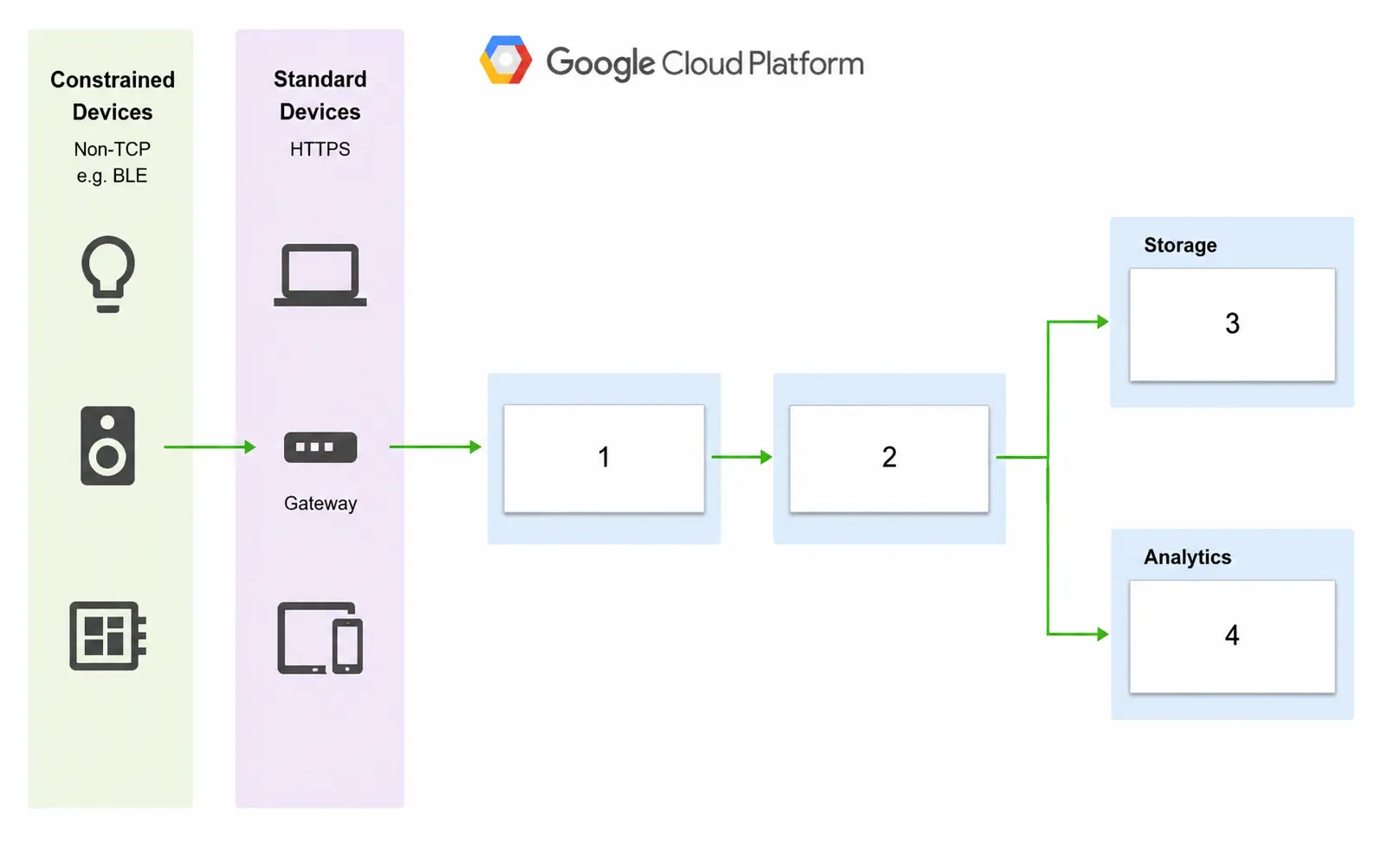

A.

Cloud Pub/Sub, Cloud Dataflow, Cloud Datastore, BigQuery

B.

Firebase Messages, Cloud Pub/Sub, Cloud Spanner, BigQuery

C.

Cloud Pub/Sub, Cloud Storage, BigQuery, Cloud Bigtable

D.

Cloud Pub/Sub, Cloud Dataflow, Cloud Bigtable, BigQuery

Correct Answer: D
Explanation:

[Reference: https://cloud.google.com/solutions/correlating-time-series-dataflow, , https://cloud.google.com/blog/products/data-analytics/handling-duplicate-data-in-streaming-pipeline-using-pubsub-dataflow, https://cloud.google.com/bigtable/docs/schema-design-time-series, , ]

Question #5 (Topic: Demo Questions)

You are performing a monthly security check of your Google Cloud environment and want to know who has access to view data stored in your Google Cloud

Project. What should you do?

A.

Enable Audit Logs for all APIs that are related to data storage.

B.

Review the IAM permissions for any role that allows for data access.

C.

Review the Identity-Aware Proxy settings for each resource.

D.

Create a Data Loss Prevention job.

Correct Answer: B
Explanation:
https://cloud.google.com/logging/docs/audit
Download Exam
Page: 1 / 1
Next Page