
Prepare Smarter for the 300-440 Exam
Build your exam confidence with flexible preparation resources designed around the latest 300-440 exam objectives. Practice at your own pace using PDF questions, online exam simulations, or desktop practice software.
Refer to the exhibits.
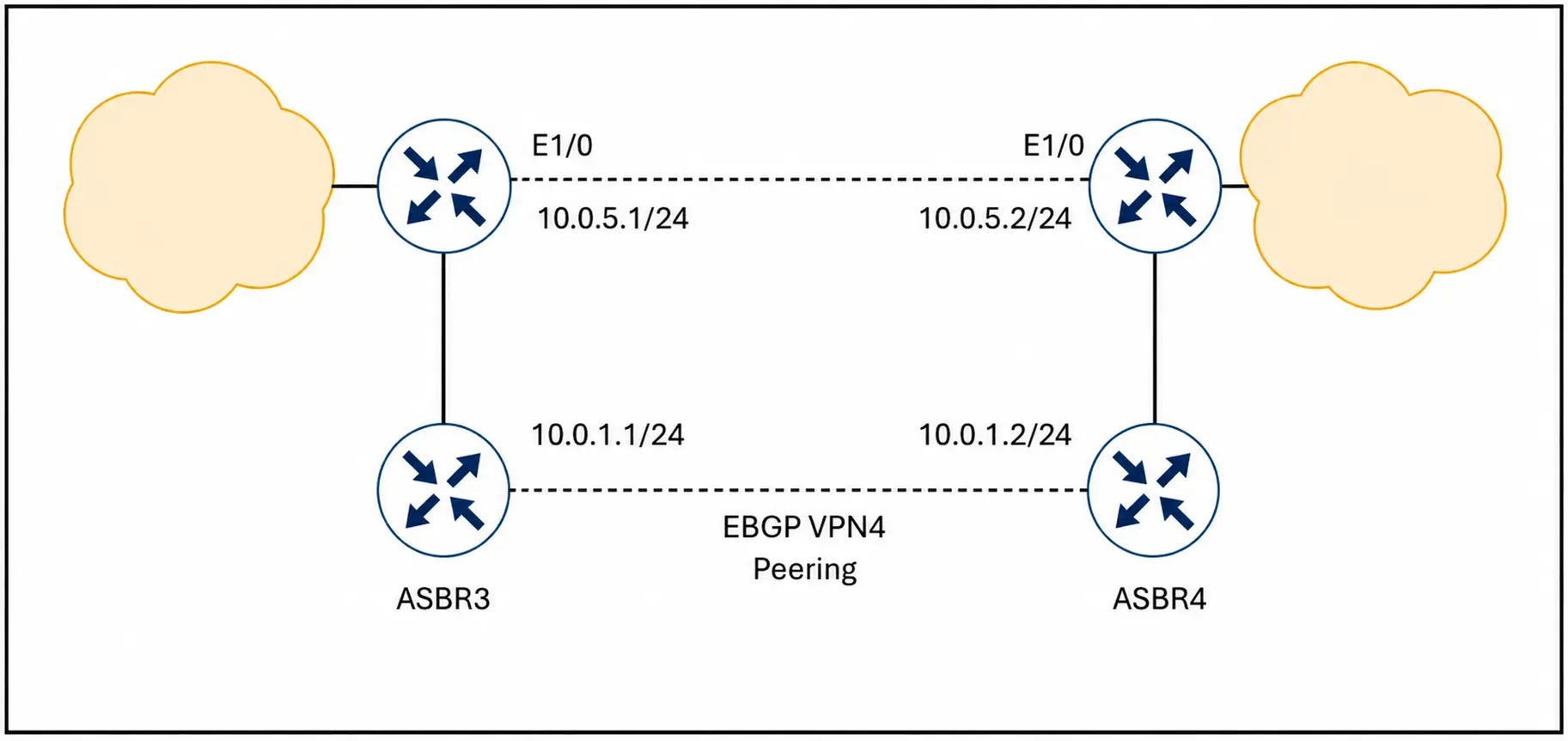
While troubleshooting, a network engineer discovers that the backup path fails between ASBR3 and ASBR4 for traffic between BGP AS6000 and BGP AS6500 when the connection between ASBR1 and ASBR2 goes down. The following configurations were performed on ASBR1:

Which command is missing?
Correct Answer: D
The bgp advertise-best-external command is used to enable the advertisement of the best external path to internal BGP peers. This command is useful when there are multiple exit points from the local AS to other ASes, and the local AS wants to use the closest exit point for each destination. By default, BGP only advertises the best path to its peers, and the best path is usually the one with the lowest IGP metric to the next hop. However, this may not be the optimal path for traffic leaving the local AS, as it may result in suboptimal hot-potato routing or MED oscillations. The bgp advertise-best-external command allows BGP to advertise the best external path, which is the path with the lowest MED among the paths from different neighboring ASes, in addition to the best path. This way, the internal BGP peers can choose the best exit point based on the MED value, rather than the IGP metric. In this scenario, ASBR1 is configured to receive additional paths from ASBR2, which is a route reflector. ASBR2 receives two paths for the same prefix from AS6500, one from ASBR3 and one from ASBR4. ASBR2 selects the best path based on the IGP metric to the next hop, and advertises it to ASBR1. However, this path may not be the best external path, as it may have a higher MED value than the other path. If the connection between ASBR1 and ASBR2 goes down, ASBR1 will not have any backup path to reach AS6500, as it does not know the other path from ASBR4. To prevent this situation, ASBR1 should be configured with the bgp advertise-best-external command, so that it can receive the best external path from ASBR2, along with the best path. This way, ASBR1 will have a backup path to reach AS6500, in case the primary path fails. References := IP Routing: BGP Configuration Guide - BGP Additional Paths … - Cisco , BGP Additional Path s
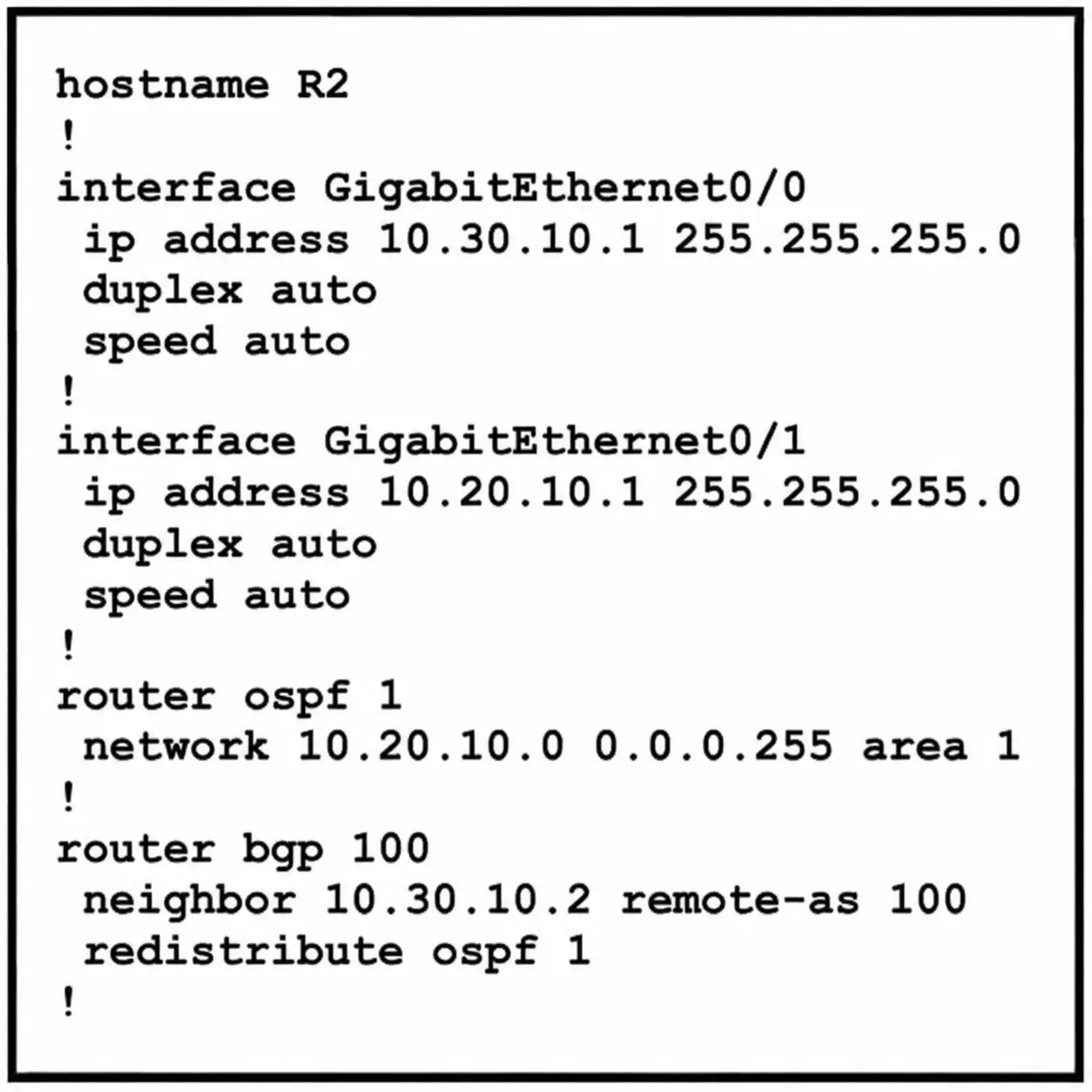
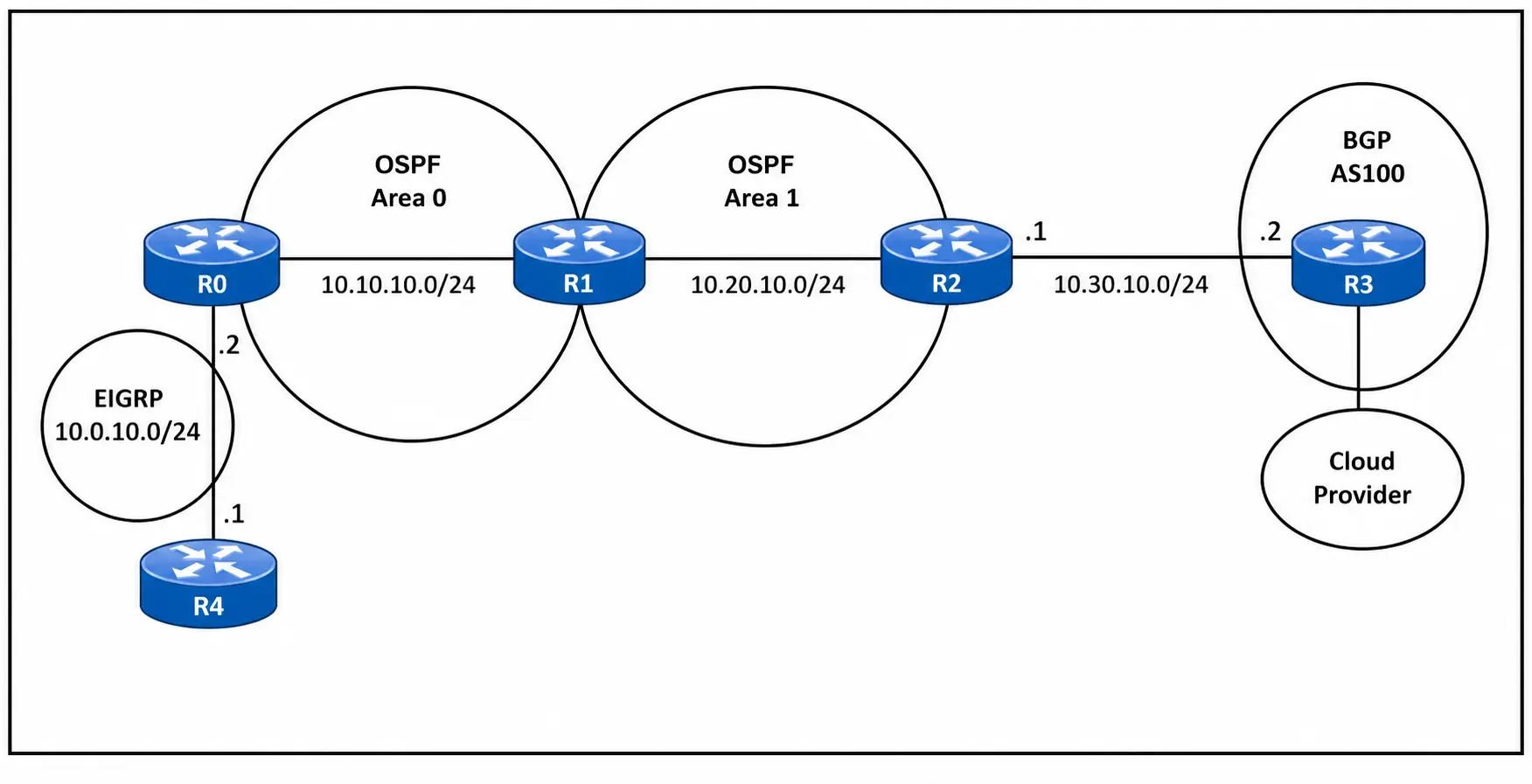
Refer to the exhibits. An engineer must redistribute only the 10.0.10.0/24 network into BGP to connect an on-premises network to a public cloud provider. These routes are currently redistributed:
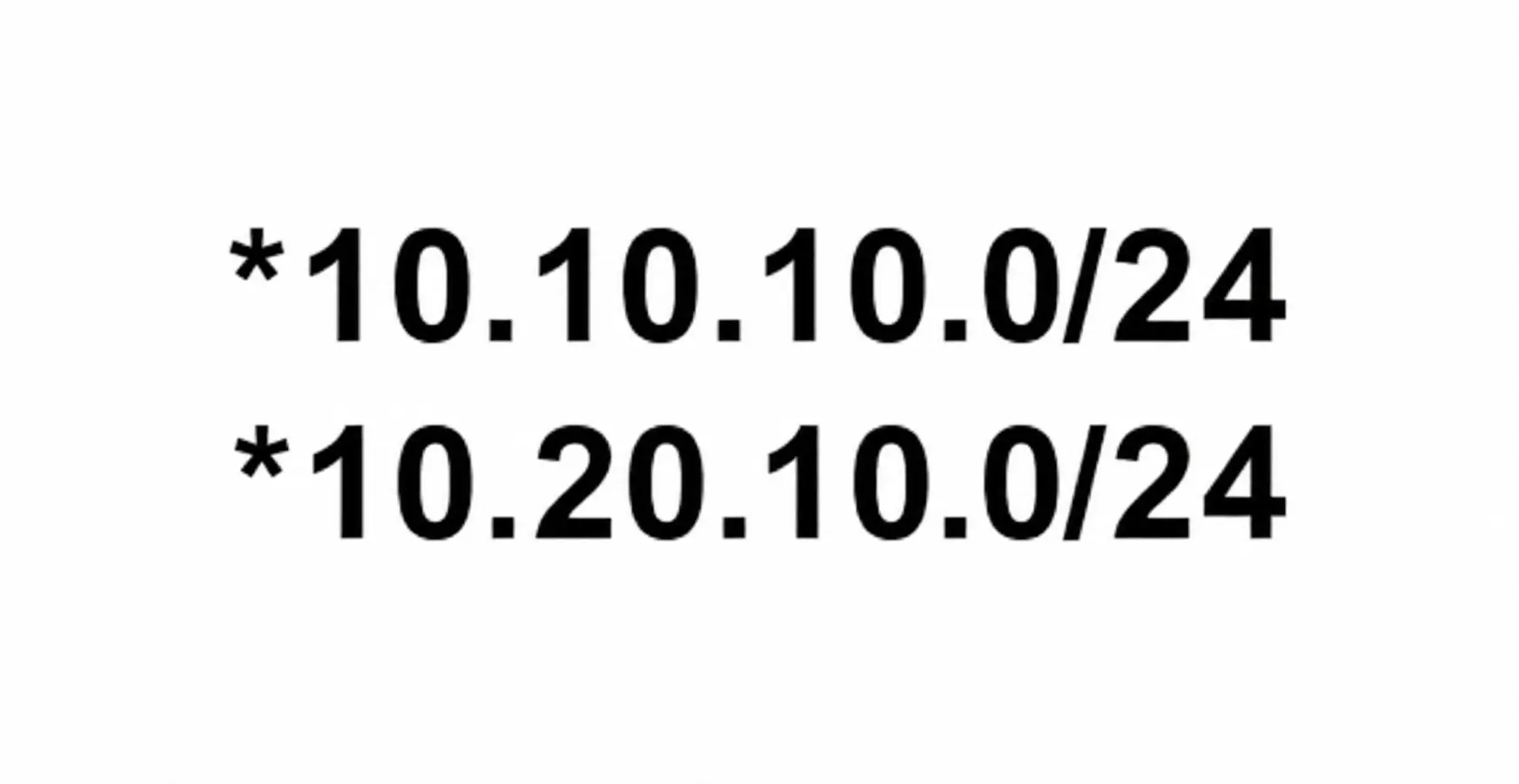
Which command is missing on router R2?
Correct Answer: C
The command redistribute ospf 1 match external is missing on router R2. This command is needed to redistribute only the external OSPF routes into BGP. The external OSPF routes are those that are learned from another routing protocol or redistributed into OSPF. In this case, the 10.0.10.0/24 network is an external OSPF route, as it is redistributed from EIGRP into OSPF on router R1. The other commands are either already present or not relevant for this scenario. References :=
Designing and Implementing Cloud Connectivity (ENCC) v1.0 , Module 3: Implementing Cloud Connectivity, Lesson 3.1: Implementing IPsec VPN from Cisco IOS XE to AWS, Topic 3.1.2: Configure BGP on the Cisco IOS XE Router
Security for VPNs with IPsec Configuration Guide, Cisco IOS XE , Chapter: Configuring IPsec VPNs with Dynamic Routing Protocols, Section: Configuring BGP over IPsec VPNs
A company with multiple branch offices wants a suitable connectivity model to meet these network architecture requirements:
• high availability
• quality of service (QoS)
• multihoming
• specific routing needs
Which connectivity model meets these requirements?
Correct Answer: D
A fully meshed topology with SD-WAN technology using dynamic routing and prioritized traffic for QoS meets the network architecture requirements of the company. A fully meshed topology provides high availability by eliminating single points of failure and allowing multiple paths between branch offices. SD-WAN technology enables multihoming by supporting multiple transport options, such as MPLS, internet, LTE, etc. SD-WAN also provides QoS by applying policies to prioritize traffic based on application, user, or network conditions. Dynamic routing allows the SD-WAN solution to adapt to changing network conditions and optimize the path selection for each traffic type. A fully meshed topology with SD-WAN technology can also support specific routing needs, such as segment routing, policy-based routing, or application-aware routing. References :
Designing and Implementing Cloud Connectivity (ENCC) v1.0
[Cisco SD-WAN Design Guide]
[Cisco SD-WAN Configuration Guide]
Which method is used to create authorization boundary diagrams (ABDs)?
Correct Answer: C
According to the FedRAMP Authorization Boundary Guidance document 1 , the method used to create authorization boundary diagrams (ABDs) is to identify all tools as either external or internal to the boundary. The ABD is a visual representation of the components that make up the authorization boundary, which includes all technologies, external and internal services, and leveraged systems and accounts for all federal information, data, and metadata that a Cloud Service Offering (CSO) is responsible for. The ABD should illustrate a CSP’s scope of control over the system and show components or services that are leveraged from external services or controlled by the customer 1 . The other options are incorrect because they do not capture the full scope and details of the authorization boundary as required by FedRAMP. References := FedRAMP Authorization Boundary Guidance document 1
A cloud engineer is setting up a new set of nodes in the AWS EKS cluster to manage database integration with Mongo Atlas. The engineer set up security to Mongo but now wants to ensure that the nodes are also secure on the network side. Which feature in AWS should the engineer use?
Correct Answer: B
Security groups are a feature in AWS that allow you to control the inbound and outbound traffic to your instances. They act as a virtual firewall that can filter the traffic based on the source, destination, protocol, and port. You can assign one or more security groups to your instances, and each security group can have multiple rules. Security groups are stateful, meaning that they automatically allow the response traffic for any allowed inbound traffic, and vice versa. Security groups are essential for securing your nodes in the AWS EKS cluster, as they can prevent unauthorized access to your Mongo Atlas database or other resources. You can also use security groups to isolate your nodes from other instances in the same VPC or subnet, or to allow communication between nodes in different clusters or regions. References :=
AWS Security Groups
Security Groups for Your VPC
Security Groups for Your Amazon EC2 Instances
Security Groups for Your Amazon EKS Cluster